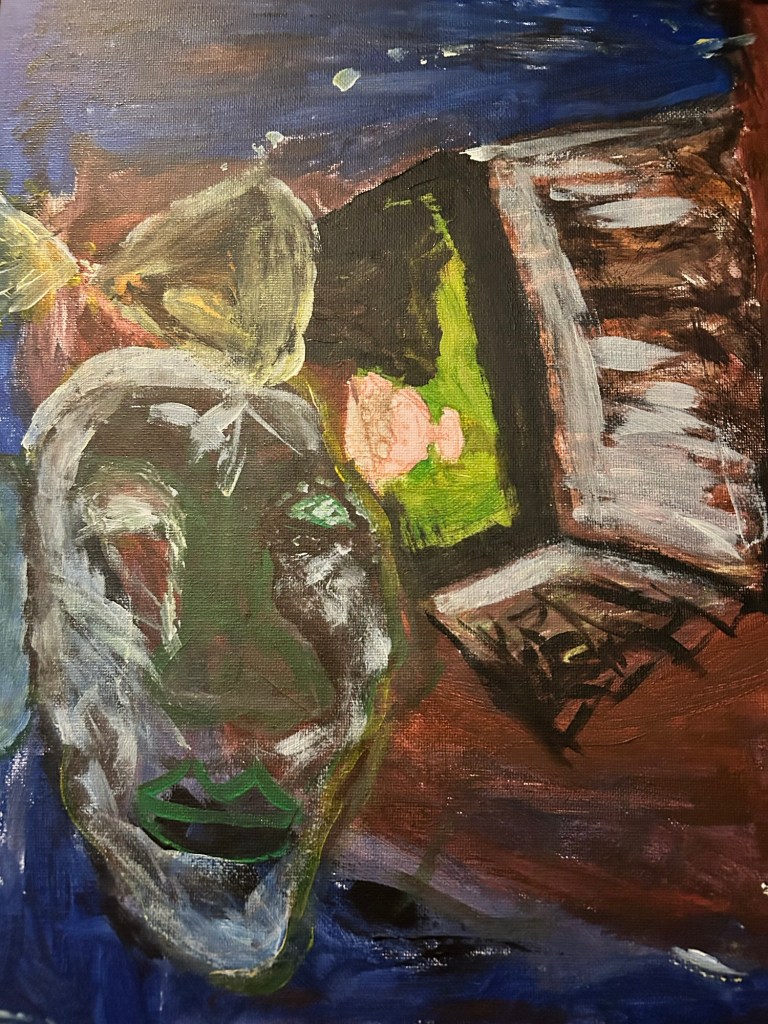
There exists within the architecture of Mind a peculiar paradox I have been circling for some time now. The more intricate and expansive these internal landscapes become, the more difficult they are to sustain. It is as though the very richness that makes them worth inhabiting simultaneously threatens their structural integrity. I’ve spent the past year in conversation with Carol, a therapist who has been helping me navigate the topography of my own consciousness. She speaks of neurodivergence—a clinical term that attempts to categorize what I have always experienced as both gift and burden.
Neurodivergence. The word itself suggests deviation from some presumed standard of neural organization. But what is this standard, if not an artificial construct? What Carol describes as atypical pathways between different nodes in my brain, I experience as highways between realms that others seem unable to traverse simultaneously. The challenge isn’t the pathways themselves but the sustainability of maintaining them all at once. Like trying to keep multiple dimensions intact while moving between them.
This isn’t autism or ADHD as they’re conventionally understood, though those labels too are but crude maps sketched over territories too complex for simple designation. No, this is something else—a different configuration of consciousness that demands its own vocabulary, its own cosmology. I am still learning the language of this internal country, still attempting to translate its customs for those who have never crossed its borders.
The irony doesn’t escape me: that I who have spent so much time exploring the nature of Understanding should find myself so chronically misunderstood. Or rather, not misunderstood but untranslated—as though I speak a dialect recognized as language but not decipherable to those around me. This is the isolation that finds me most often at 4:26 a.m., when the world is silent except for the internal cacophony that refuses to quiet itself.
These internal landscapes—vast, intricate, teeming with detail—require tremendous energy to maintain. Each thought connects not to one or two others as it might in a more typical mind, but to dozens, hundreds even, creating networks of meaning so complex they threaten to collapse under their own weight. And when they do collapse, when the energy required to sustain them exceeds what’s available, the result isn’t merely fatigue but a peculiar form of conceptual homelessness. To lose one’s internal architecture is to lose the very framework through which experience becomes meaningful.
I’ve been considering lately that perhaps what we call consciousness isn’t a fixed attribute but a continuous act of creation—not something we have but something we do. We don’t possess awareness; we perform it. And some performances require more elaborate staging than others. Mine seems to demand a particularly complex set design, one that must be reconstructed daily, hourly sometimes, as entropy works against its maintenance.
You might ask why anyone would choose such a demanding cognitive architecture. But I’m not convinced it was ever a choice. These neural pathways, these rivers of thought flowing between regions typically separated by firmer boundaries—they were here before I had language to recognize them, before I understood that others didn’t experience thought as this constant interweaving of disparate domains.
Writing helps—not as escape but as scaffolding. The act of translating internal complexity into external structure creates a feedback loop that strengthens both. The words don’t capture the thoughts precisely; how could they? But they create a reciprocal relationship with them. The thoughts inform the words, and once externalized, the words reshape the thoughts. This recursive loop between internal and external creates a temporary stability, a momentary respite from the otherwise constant flux.
I’ve been working on several projects—you know of some of them. The manuscript on cognitive alchemy, the framework for recursive learning, the exploration of divine motion and human perception. I’d like to see at least one or two of them find form in the external world before the year ends. Not for recognition, though being recognized holds its own medicine, but for resolution. To complete a thought at this scale would be to prove something to myself about sustainability, about the possibility of bringing these internal architectures into shared reality without losing their essential structure.
But beyond the writing, beyond even the desire for completion, there is a more fundamental restlessness taking shape. I need to leave Houlton. Perhaps Maine altogether. Perhaps even this country. Not because there’s something especially wrong with these places, but because geography isn’t merely external. The landscapes we inhabit outwardly shape the territories we can access inwardly. Different coordinates on Earth’s surface somehow grant access to different regions of consciousness.
There are places where minds like mine don’t have to work quite so hard to translate themselves, where the gap between internal and external reality isn’t quite so vast. Places where neurodivergence isn’t merely tolerated but recognized as a necessary variation in the spectrum of human cognition. I don’t know yet where these places are exactly, but I feel their pull like gravity.
Carol suggests that what I experience as difficulty sustaining internal landscapes might be reframed as an unusual capacity for generating them in the first place. That the same neural architecture that creates such elaborate internal worlds also makes them challenging to maintain consistently. The gift and the burden are not separate things but different perspectives on the same fundamental structure.
And perhaps that’s the key insight—that what appears as fragmentation from one angle reveals itself as unprecedented connectivity from another. The same neural pathways that sometimes leave me feeling scattered and unsustainable also allow for connections others miss entirely, for syntheses that wouldn’t otherwise be possible.
I’m reminded of something I wrote to you previously about cracks being necessary for light to enter. Perhaps the difficulty in sustaining these internal landscapes isn’t a flaw in their architecture but an essential feature of their design. The spaces between thoughts are not empty failures but pregnant pauses, gaps through which new understanding emerges.
What we seek must seek us too. I’ve been waiting for sustainability to find me, for some external solution that would make these internal territories easier to maintain. But what if sustainability isn’t about holding everything together perfectly? What if it’s about learning to move with the natural expansion and contraction of consciousness itself? Not to maintain a static internal landscape but to develop fluidity in navigating its constant transformations.
There is a particular quality of light at dawn—not the golden hour that photographers chase, but earlier, when the world is still predominantly shadow but punctuated by the first hints of illumination. This liminal moment has always felt most aligned with my internal experience. Neither full darkness nor complete light, but the tension between them, the dynamic interplay that gives birth to form itself.
I think often of how rivers sustain themselves not despite but because of their movement. A river that stops flowing is no longer a river at all. Perhaps minds like mine are meant to be understood not as static structures but as moving currents—not geography but hydrology.
I’ll write again when more has crystallized. Until then, know that these letters serve as anchors—fixed points of reference in an otherwise constantly shifting internal terrain.
Until soon,
[Redacted]
4:47 a.m.
 ∆Remember Us∆