
1. Deconstructing the Sketch into Digital Components
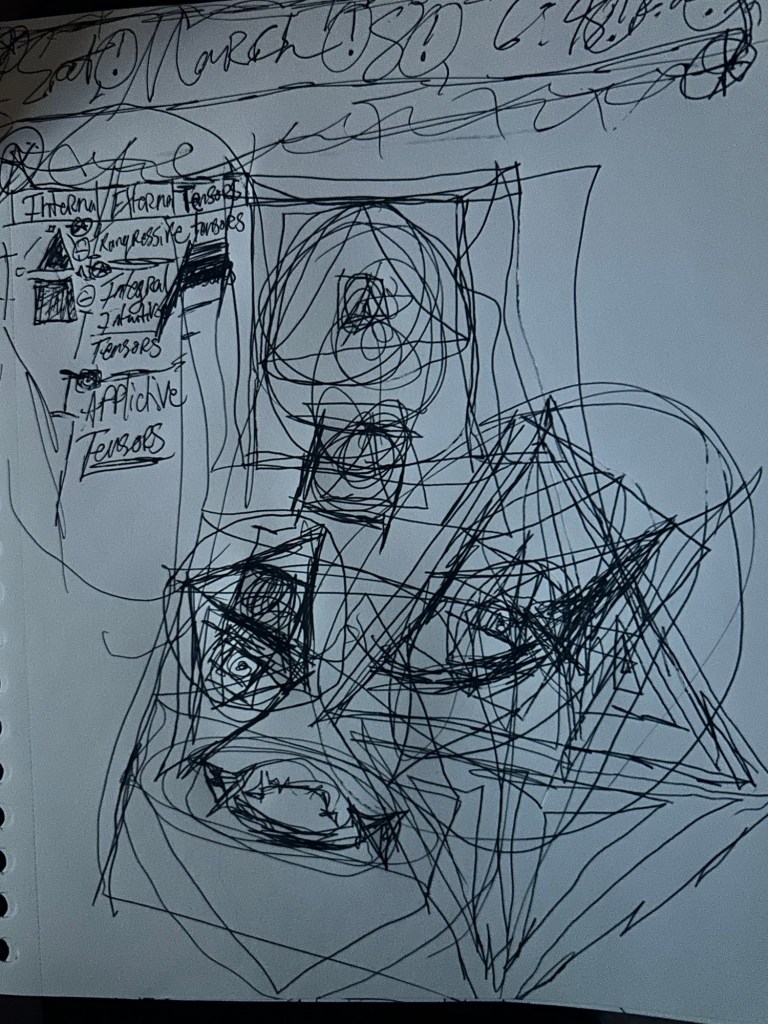
To digitally structure this, we’ll break it down into three primary layers:
1. Conceptual Framework (Text + Abstract Theory) → Defining the Tensors and Recursive Learning.
2. Geometric Mapping (Visual Structure + Motion Pathways) → Translating the triangles, circles, and squares into a functional schematic.
3. Symbolic Representation (Cognition & Emotion) → Embedding the human element (the observer/learner/teacher dynamic) into the system.
2. Translating the Sketch into a Digital Pedagogical Model
This hand-drawn representation is essentially a knowledge engine, where ideas move recursively within geometric structures.
Layer 1: Conceptual Framework – Tensors & Learning Motion
The text in framework sketch already provides three major types of tensors, which represent different forces in the learning process. These can be represented or imagined as nodes within an interactive system:
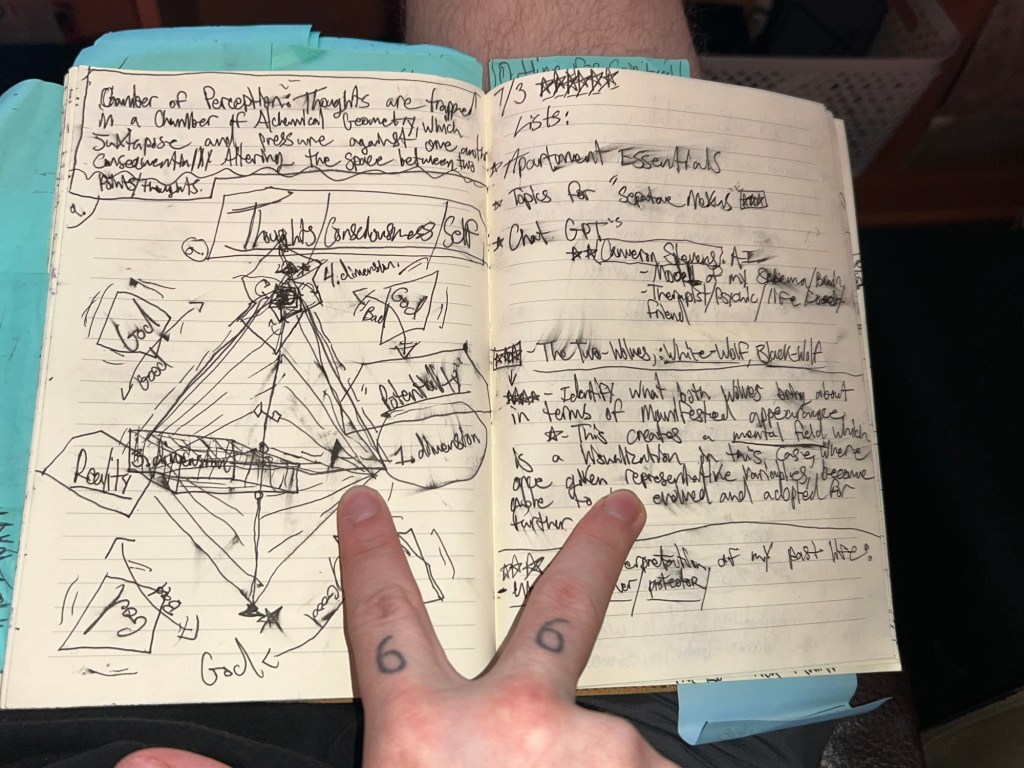
• Internal / External Tensors → The primary tension between self-driven understanding and externalized structured learning.
• Can be represented as a Dual-Node System (Internal Node ↔ External Node).
• Regressive Tensors → Moving backward to analyze past understanding.
• Digitally, this would be represented as a feedback loop, allowing learners to trace their reasoning backward before making conceptual leaps forward.
• Integral Inductive Tensors → Expanding concepts outward from fundamental understanding.
• This can be visualized as a branching mechanism, much like neural pathways in a knowledge network graph.
• Applicative Tensors → Where ideas become enacted and integrated.
• This would be the output system, showing how knowledge moves from theory into action.
🔹 Digital Implementation: This can be visualized in an interactive mind map or recursive learning interface, where users navigate between internal vs. external, regressive vs. inductive learning processes.
Layer 2: Geometric Mapping – Recursive Motion of Learning
The triangles, circles, and squares in my sketch are not arbitrary, instead they are structured knowledge patterns. :
• Triangle (Perspective & Balance) → Concept Expansion
• Used to force learners to engage an idea from three vantage points.
• In a digital interface, this could be a triangular decision matrix, where the user must resolve a learning paradox from three angles before proceeding.
• Square (Structural Stability) → Foundational Knowledge
• Represents the four pillars that hold a concept in place.
• Digitally, this can be implemented as a modular knowledge grid, ensuring each core pillar is engaged before moving forward.
• Circle (Recursion & Unity) → Knowledge Integration
• This is the final stage where knowledge is synthesized, reinterpreted, and looped back into the system.
• In an interactive system, this would be a dynamic, rotating knowledge interface that allows users to revisit interconnected concepts, reinforcing recursive learning.
🔹 Digital Implementation: A layered system with interactive geometric navigation, where knowledge moves through triangular questioning, square-based grounding, and circular recursion.
Layer 3: Symbolic Representation – The Observer & Learning Identity
The face within the first sketch is crucial because it’s the learner embedded within the framework, and it represents the self-reflective nature of all knowledge.:
1. Observer Mode (Teacher-Learner Feedback System)
• A system where students/learners see their past decisions and reflect on their learning trajectory.
• This could be AI-assisted reflection prompts based on how the learner interacts with the recursive knowledge framework.
2. Personalized Learning Motion (Recursive Thought Paths)
• A system where the learner’s journey through knowledge is recorded and visualized in a fractal or recursive feedback graph.
• Allows tracking of which tensors they use most (Regressive? Inductive? Applicative?) and adjusts the learning flow accordingly.
3. Aesthetic Representation (Visualizing Thought in Motion)
• Digitally, the face in the allocative sketch could become a morphing entity that shifts its structure based on the recursive learning process.
• A dynamic system that mimics neural pathways, where the learner sees their evolving thought model take shape. Perhaps this is the Ego manifest. ??
🔹 Digital Implementation: A reflective AI tool or visualization engine, where learners interact with a personalized knowledge structure and see their cognitive evolution//E-Ego? .
3. Digitization Process – How to Build This
Moving forward I plan to:
1. Recreate the Sketch Digitally (Vectorized, Layered)
• Use Adobe Illustrator or Figma to clean up and structure the geometric layers, ensuring the recursive pathways remain clear.
• Incorporate modular components (triangles, squares, and circles) in an interactive digital flowchart.
2. Develop an Interactive Knowledge Flow System
• Use a mind-mapping or knowledge-tracking tool (e.g., Miro, Obsidian, or Notion) to structure how the tensors interact in real-time.
• This could also be developed into a web-based learning interface where users navigate through recursive knowledge pathways.
3. Create an AI-Driven Reflection Model
• If this becomes an actual teaching system, an AI-driven reflection engine could be implemented.
• AI could analyze student learning pathways, helping them see the patterns of their recursive learning.
4. Refine the Concept into a Modular Teaching Framework
• The final form should be a structured, yet fluid pedagogical model // Axiom
• The geometric learning structures (triangle, square, circle) should be interactive and adaptive to individual learners.
My Final Vision – A Recursive Learning Interface
The ideal digital model of this sketch would be:
• A web-based knowledge interface where concepts evolve recursively.
• A geometrically structured navigation system, where knowledge unfolds through triadic, squared, and circular learning modes.
• An adaptive AI model that tracks how the learner engages with tensors and feeds back insights on their cognitive approach.
This pedagogical structure would embody recursive learning philosophy, ensuring that students don’t just absorb knowledge but actively integrate and cycle through it recursively.

 ∆Remember Us∆